 |
 |
For Table of Contents click on the logos. |
|
|
For Table of Contents click on the logos. |
1. Beginning |
10. Action |
| Beginning | The Labyrinth of the Spirit grew from my desire to find a problem solving method that could uncover my personal biases and blindnesses. ^Top |
|---|---|
| Extension | With myself as an example, my worst problems seemed to arise from circumstances I couldn't, or wouldn't, see. Either I wasn't aware, or I locked myself out of possibilities, probably because of denial due to the prejudices I held, consciously and unconsciously. The method, to succeed, had to expose the possibilities I was unwilling or unable to consider. ^Top |
| Value | Since logic is most often used to exclude, which my biases were already doing, the method had to be inclusive, bypassing logic when needed. Using logic to extend and include possibilities suggested by intuition, rather than limit and exclude them, seemed a rational way to uncover possibilities, then develop their probabilities. ^Top |
| Use | Realizing probabilities bring effects that may be either positive or negative. These are actual outcomes that ultimately demonstrate the purpose of the action taken. ^Top |
| Knowledge | Knowing that entrenched desires and beliefs, no matter how sincerely held and well considered, can have negative outcomes is a sobering thought. My own experiences, experiences of my friends, acquaintances, and strangers, and the fate of groups, companies, societies, and nations show that negative outcome is highly likely. The method had to extend limited insights, no matter how sincerely held and well considered, into the realm of reliable knowledge. |
| Personal behavior is usually logical and intuitive within the limits of its understanding. Yet these qualities often fail to provide the desired effect. Or when the desires have been realized, the satisfaction predicted is not! It seems irrational that logic and intuition aren't always sensible, but this was a method intended to resolve that irrationality. ^Top | |
| Theory | Logic and intuition is rationality that can lead to irrational errors. Irrational behavior can be corrected when accompanied by a sincere desire to be rational. Behavior is based on personal ideals, where all intentions, including the desire to be rational, arise. The spirit in which ideals are created determines what they are, and they can be anything, because ideals are often created "in the spirit of the moment." ^Top |
| Desire | I really wanted this process to be valid. I felt that great issues and great insights not only were beyond me, but actually were not necessary. This had to be a method anyone could use, modify, or ignore, as they wished. I wanted to enjoy the process, the exploration, the research, and creation, without investing my time and effort in a specific outcome. I wanted to discover what the outcome was. The reason for publishing is to see if the method can bear critical analysis. I am satisfied with what I have done. If it brings satisfaction to you, good. I have enjoyed 18 years (And 18 models, would you believe?) of off-and-onactivity, exploration, and revelation. Small revelations, mind you. Big revelations belong to those who are satisfied with nothing less. ^Top |
| Concept | I began with a long list of words ordered according to their shades of meaning. Many had multiple meanings when used in different contexts, suggesting the possibility of multiple dimensions. For easier management, I kept the lists in two dimensions, with the word meanings varying in both "horizontal" and "vertical" directions. More dimensions were too complex to consider, so any three dimensional qualities of the model had to grow from the two-dimensional base. How the model did grow was as much from synchronicities as from intuition and logic. That is, I stumbled on certain resources when ready for them. For example, Robert Sternberg's book The Triarchic Mind, an important resource for the Labyrinth of the Spirit, was randomly picked off a library shelf one day while searching for something else. ^Top |
| Consistent | The shadings of meanings in the words were in some instances subtle and obscure. I looked for a way to organize them without forcing preconceived relationships. I had remembered the Luscher Color Test, which we had played as a parlor game, and how colors signified attitudes. Other references, however, did not agree exactly which colors applied to exactly which attitudes, but all agreed generally that colors approximate similar human values. So, both words and colors symbolized human values.As spectrums they have similar structures when comparing shades of color to shades of meaning. ^Top |
| Action | Communication is taught with the Sender-Message-Receiver (SMR) model describing the basic elements of a communication. Red, yellow, and blue are the spectrum's primaries colors, producing white. Each set of three provides a "complete communication," if you will, in its own milieu. |
| The first expansion of the color spectrum comes by halving the differences between red, yellow, and blue, producing orange, green, and violet, for a total of six. Combining these three new colors also produce white. Halving the colors again doubles the total to 12 colors. Beyond 12 colors, the differences in color become too subtle, and lose distinction. It seemed that, beyond 12 levels, the differences in meanings of words also would become too subtle, and lose distinction. It was on this nebulous, yet definite, color structure that work proceeded. | |
| The word lists were organized in a 12 by 12 table, marked by the 12-color spectrum along both vertical and horizontal axis. At each of the 144 intersections within the table, colors combined to produce a variety of shades. And, of course, along the diagonal of the table the colors matched. Throughout the rest of the table each intersection produced a unique shade of color, which was paired with its corresponding word. Viewing the entire color table revealed a kaleidoscope of variance resulting from the combinations of colors. Grouping words in the table according to colors indicated that 12 steps were not enough to describe the complete process. ^Top | |
| Production | I was more interested in the process than the result, and confident my
playing would discover something of value. Rather than force values on it, however, I wanted a structure to emerge.
Following a lengthy process, what emerged was a matrix of 18 elements, represented graphically in circular color spectrum
below, which is the logo of the Labyrinth of the Spirit. The spectrum emerged from the process of designing. It
was created with no structure in mind but to maintaining the integrity of the process. Note that red, yellow, and
blue form an isosceles triangle that maintains the white-forming relationship when rotated (theoretically). Yellow
corresponds to the first of the 18 models in the Labyrinth of the Spirit:
1. Insight. Blue corresponds to 5. Knowledge, and red to 15. Importance.
 The next spectral trio is green, 3. Objective, then violet, 7. Relationship, and orange, 17. Solution. These trios hold true all the way around this 18 color spectrum, which is shown in the Table of Contents. The colors in the spectrum between violet and red begin with purple, then the invisible ultra-violet to infra-red range of the spectrum is represented. However, rather than explain the tedious and obscure process of development of all the models, let me describe the serendipitous synchronicity that supported the scheme, which includes both the two by nine Will Track and three by six Mind Track. ^Top |
| Verification | Liberally summarizing a small part of its content, Robert Sternberg's book The Triarchic Mind described two problem solving methods. The first was a three part model, the second was a six stage inferential model. Sternberg described the three part problem-solving model as adapting to a circumstance, selecting means and methods, then shaping a solution. This paralleled the SMR communications model (Sender-Message-Receiver). If the sender adapts his message to an environment that includes a receiver, then selects a means and method for transmitting the message acceptable to both sender and receiver, then the communication is shaped in the receiver. |
| The Triarchic Mind also described a six stage inferential method, which encoded the problem, inferred a method, mapped the problem onto the method, applied the parameters of the problem, proved the solution, then resolved the result. This six-stage method is called the Language of Proof, shortened to the word Proof.. | |
| Even more fruitful was the section of the Sternberg's book regarding his research into types of thinking. It described three types of thinking, each arranged into six categories, forming, very conveniently, the 18 cell matrix that satisfied the both the SMR and Language of Proof. | |
| Sternberg also discussed error thinking, which proved to be very significant in the development process. ^Top | |
| Performance | I had captured the essence of a valid method, and proceeded to build the first model, which was 17. Solution, intended for general problem solving, because that is what I was trying to do. To my mind, the most common problem is communication--between people, with one's self, and with the environment, so Model 8. Communication, came next. I used the first model to develop and check the validity of the others, and vice versa. To be consistent and thorough, I cross checked every model this way, comparing each against all the others. They had to agree, therefore personal preferences and prejudices were secondary to the process. |
| Communication requires agreement on the context of communication, if nothing else. The models indicated that a problem solved or something communicated affects thinking. and subsequently, doing. In other words, affect results in effect. And an effect is realized through change. If no change, nothing has happened. If there is no effect, there was no cause! Change is an effect resulting from a cause. The need to solve a problem or to communicate is a cause. That cause seeks change. The change is an effect that becomes the cause of the next thing to happen. Reducing this cause/effect chain to its basic form means change is a change in behavior. In a chain of events, the change is what matters. | |
| Cause and effect is a process that describes behavior that will not happen without the power of the Will—conveniently desribed as Willpower. Willpower does not use the three- and six-step process that provides thoughtful behavior. Operating just in a cause/effect mode merely extends the way one is inclined to behave. If such behavior delivers an undesirable result, then the Mind is used to bring about change. Willpower DOES DECIDE to use the Mind, then DOES DECIDE to how much and when to make the change the Mind recommended. How weak or strong is Willpower to make the change? | |
| This meant that two sets of models were needed: the Will Track, to describe Willlpower-ed behavior, and the Mind Track, to describe how behavior might be changed. | |
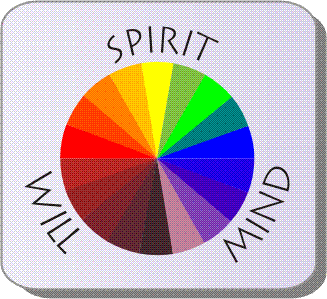
| The Will Track, with the 18 steps arranged into a two by nine table,
describes a paired cause/willpower/effect relationship. In the color spectrum
above, the 1-9 half starting with yellow ending on ultra-violet is symmetrical to
the 10-18 half beginning with black and ending on amber. Paired this way, they
show a complementary cause/willpower/effect relationship. The first column,
consisting of models 1. Insight through 9.
Involvement, are the causes. Any event can be
related to a single cause. The Butterfly Effect, for
example, presumes a chain reaction of cause/power/effect, some very subtle,
some dramatic, resulting from a cause. A common explanation of the Butterfly Effect supposes the
flapping of a butterfly's wing in China as the cause of a
tornado in Kansas. By this idea, then, each cause
has universal effects. The first universal effect is described by
matching the causes—1. Insight to its effect: 10.
Means, through 9. |
|
| In personal terms: one small decision can cause a huge change. | |
| Cause, Willpower, and effects produce behavior. The Will Track's third column describes the behavior characteristic of each cause/willpower pair. | |
| The Mind Track, a three by six table, describes the thoughtful process applied if the will goes astray. However, the three columns are no longer labeled Cause, Willpower and Effect, but Cause, Decision, and Effect. Each of the these three elemets of the Mind model must meet a standard of proof (described in the next paragraph). This is where the title, Labyrinth of the Spirit comes from. A Labyrinth is a long path with many turns, but a definite end. Spirit because spirit is defined as the animating force that drives humanity. In terms of a learned process, Will (and its Willpower) express this force. However, if change is to occur, Mind is employed to begin the learning process. Then, for a change to mean anything, the body must exercise and experience it. Without experience, change remains thought. The physical provides experience. | |
| But proof is not simple. The six levels of proof, to be fully appreciated, must be acceptable to the Will, the Mind, and the Body. The individual chooses the method of proof. Here,it is desribed as: encodes, infers, maps, apply, proves, and resolves. The route can either pass simultaneously through all three in parallel, each consecutively—one step at a time, or leap from one to the other, just like in real life. One can "jump to conclusions," on a unique path. Whatever path is taken, the Will sees a cause, then creates an effect forced by the fast and efficient Willpower. Mind encodes the cause, makes a decision, and experiences the effect. Either Will or Mind can resolve the problem (described as a "cooncern," but the Mind wants proof. | |
| Each model was developed from previous models, but not as numbered consecutively. During development, each found a place congruent with its function in the overall scheme . As related previously, the problem-solving and communication models were first. Communication is expressed in relationships, so 7. Relationship came next. Since trust in the relationship is important, 8. Involvement followed. Oddly, 12. Verification looked like a sales model, which seemed to give it a mercenary slant. This was unacceptable. But a seller needs a buyer. "Buying" means accepting and approving, and where does this matter most, but in a relationship, for example? Therefore, what is "bought" depends on the context, from a romantic relationship to taking a drink of water, to admiring a real or painted landscape, to acquiring a candy bar or an automobile. The relationship determines what the terms are, and what should be verified. | |
| Considering which terms really do matter led to 14. Leadership. Based upon spiritual principles articulated in Ba'hai literature, it deals with the fact that fundamental relationships anywhere in the universe are based on universal truths, and that falsehood is misleading. But truth and falsehood are in all vocabularies. The models could remain on an intellectual plane, secure in the mind, where everything seems real until it meets the truth of experience. Now, it seemed important to reduce the models to personal terms so the meaning of each step would extend into the vocabularies of each model. | |
| Willpower forces, Mind decides, and body experiences are parallel to the subjective, intuitive, and objective qualities of being. The Will is fast and efficient It knows how, so doesn't need to reason, so operates subjectively. The Mind requires proof before making a decision. The decision-making process also requires proof, as do the effects resulting from the cause and decision. This seems like a subjective process, but is not, because proof can come from many sources&mdashsome concrete, some abstract. Abstract sources of proof depend upon intuition. Intuition, basically, is knowing what without knowing why. Sometimes, this source of proof is more trustworthy than concrete measures. Because of this, the Mind is intuitive. Reality is objectively gained from experience. A trap in behavior: experience is often interpreted subjectively, but Willpower follows a subjective path. A person may claim objectivity or intuition, but really be subjective. | |
| For Proof to be effective, the real concern must be perceived before it can be encoded. Then, meaning is inferred. The inferences are mapped onto the situation and applied, assuming there is power to do so, and proven, supposing sufficient knowledge is available to appreciate the results. Finally, is the situation resolved or not? Is the purpose realized (or not)? In the Mind, Cause, Decision, and Effect have positive meanings at each level of Proof. See 2. Extension. Awareness of a concern brings an insight, so 1. Insight was created next. On having an insight, 10. Means are necessary to extend that insight. 2. Extension, then, made sense, matched with 11. Method, which describes a way to extend. Then 3. Objective(s) are set, then 4. Resources are found to achieve those Objectives. 5. Knowledge, and 6. Purpose naturally arise for the original insight. Note that 6. Purpose discusses philosophies. The rest of the models were more or less developed simultaneously, each checked against all the others. ^Top | |
| Definition | The method, if truly viable, should correspond with methods that already
existed. My research, as should yours if you care to undertake it, did discover
three step methods, six step methods, a prominent seven-step method,
and others, including the 12-step Alcoholics Anonymous process that corresponds roughly to the models.
Particularly worth noting are 13. Performance, which is matched to the
Myers-Briggs typology for career evaluation, 15. Importance incorporates the standard
business model, but this can be deceiving. It is easier to understand if concrete concerns like
dollars are used. This modelalso applies to purely abstract concerns. Abstract is harder to measure than
a profit measured by numbers. This is why Model 18. Revelation of the insight is
concerned with discovering a truth of the concern which generated the insight that began this process.
This process is aware of the qualities of the spiritual teacher described in The Teacher's
Manual a part of *A Course in Miracles
(Copyright 1975 The Foundation for Inner Peace).
INTERESTING SIDEBAR |
| Use of the mind doesn't prevent errors. In many circumstances, logic encourages error because behavior, desiring to be seen as reliable, uses the mind to appear consistent when actually not. Changeable behavior is erratic, unpredictable, and unreliable, which reflects badly on the changeable individual. Nevertheless, once a truthful insight is gained, change is inevitable. The mind is then used to resolve the apparent errors. It is powerful, and tries hard. But something else drives the vast machine of the universe and the part of the universe that occupies the individual mind. The Will that drives behavior is subject to the WILL that drives the universe. The mind can decide, but unless that decision changes behavior, it had no effect. Changes of mind only have meaning when changes of behavior follow. I believe this is the will of the universe. Unacceptable behavior has negative effects, hopefully producing experiences that encourage a change of behavior. Will and mind may be in agreement or in opposition. This is a personal decision. ^Top | |
| Decision | Will is of the spirit. Behavior is evidence of the Will's power and the proof of existence. The mind is used to change unproductive behavior. The Mind, serves the will, and tries to support the Will's behavior, but a fearful will ignores the proofs by the Mind and willfully continues in error. A horrible error7mdash;the Will allows the Mind to believe it is in charge. If the mind was aware it was the servant, not the master, and the Will was aware it was subject to a greater will, error would not be so common! Revelation would come quickly. |
| Yet meaningful revelation must be a conscious experience. If behavior is instinctive, it is unconscious, despite claiming not to be. What is normally accepted as thought is behavior that supports the Will's misconceptions instead of helping to correct them. The evidence of real thought is a change of mind, not the maintenance of dysfunctional behavior, no matter how popular or proper it seems. | |
| In terms of the Labyrinth of the Spirit, the Will describes behavior, and when willing, uses the Mind for proof that it's on the right track. Individual spirit chooses the path. The decision is always between willful belief and the truth, between misconceptions and reasonable concepts, between preconceptions and accurate perception, between imagined events and reality. In most simple, yet comprehensive terms, the decision is between fear and love. ^Top | |
| Acceptance | Decision evolves in an experiential context. If satisfactory, it is accepted as is. If not satisfactory, the a new context is sought, which requires a change of mind. Doing things the same way, hoping that this time--at last--things will turn out differently, is supposed to be an evidence of madness. Conviction and faith are not madness when based on truth. They are madness if based on falsity. Which provides an acceptable context, falsity or truth? |
| Context is important. The context of the models is not a rigid structure, even when appearing rigid. Practical experience shows that people operate in different contexts, sometimes more than one simultaneously. These are called "grey" contexts. The phrase "Nothing is black or white" applies, though disproved by the fact that some things are black, and some are white. | |
| The models are a reference, not a prescription. The path taken is a choice. What applies, applies. Follow the path the will chooses until deciding to choose differently. Experience decides. Yet, with the Will, anything is possible, maybe even probable, because it is part of the same Will that drives the universe. Each spirit has a unique point of view, and behavior is subject to the perception of the moment, which, in turn, has been subject to nature and nurture. The "point of view" is the real context. Accept this fact. ^Top | |
| Resolution | Any path can be taken, and any choice made at any time, in any situation. What does choice resolve to? Has the situation been perceived as it really is, or as wanted to be? Is now seen as it is? While situations may appear alike, points of view are different and unique. Also, some situations appear to be different, but are actually the same. Nevertheless, the point of view is still different and unique. Every solution is uniquely individual. If a concern has actually been resolved, that is also uniquely individual. Lack of a solution requires denial. Lack of resolution is likely due to prejudice. Keeping the mind open to all possibilities is very important. |
| It is fair to ask what I have resolved. I didn't start with a specific goal in mind, because that would have predetermined the outcome, which would have defeated the original purpose. I started dispassionately, being as logical as I could, so innate confusions wouldn't taint or hinder development. It became apparent that this project depended upon the spirit that started it. In spirit, my intent has remained the same for all the 34 years (and counting) the project has existed. It would seem that the Labyrinth was an ordeal because its size and complexity used up all this time. Backchecking was laborious and extensive. Since I did not start with a pre-conception (I think), I am grateful for the new insights it brought into how different disciplines all follow the same "learning process." I am grateful for the insights that came from outside myself and the people who brought them. I am grateful that societies and organizations continue to grow strong despite all its unconscious contradictions. I am grateful for the fact that, right or wrong, we all try to be better. It is fun. The excitement of discovery and invention has led to the perception that nothing is new in the universe, but waits to be found. At the end of one's search is the self--then by extension, everyone's self. For me, a lot of concerns have been resolved. | |
| I was, and am, skeptical of willful beliefs, even my own. I am skeptical of organized religions. Religiosity is not spirituality. A religion actually spiritual depends upon the individual. In this process, whatever my biases and blindnesses were, and are, I sm grateful to have found spirituality. I thought this the experience would have the opposite effect, diminishing spirituality by validating my natural skepticism. While my skepticism remains, I have learned a deep appreciation of the natural order of life, which is quite different from what is commonly assumed. I hope the Labyrinth of the Spirit contributes to a better understanding of the natural order. I am grateful for perhaps glimpsing a will above and beyond our own, beyond all imaginings, efforts, skepticisms, and denials, and prejudices, that has an infinitely open mind.. ^Top | |
| Revelation | Revelation comes when the individual Will agrees with the Will that drives the universe. Any such agreement is an insight into truth. True insights are validated by behavior that creates the greatest good. The choice is simple, between bad and good, between fear and love. If only it were simply made. The only real hindrance is an attitude prejudicial to the possibility of true insight. Any insight into truth, no matter how small, is a revelation. And one revelation promises others. |
| Please note that model 18. Revelation describes a spiritual process based on truth that is identical in every model. Only the vocabulary changes to accommodate the subject. The last step in 18. Revelation links back to the first step in Model #1. Insight and will, until the last true insight. | |
| Many insights need to be gained, lessons learned, behaviors changed, and revelations come. Where it ends, God only knows. The will, being free, needs to make right choices. I think (but don't know) that each of us was created as spirit with a will free to decide. It has been said that all ways lead to God, so it doesn't matter which way you go. Some ways are longer and more painful. I hope that the Labyrinth of the Spirit helps reveal the way. ^Top |
| Copyright | *The adaptation of The Teachers Manual of *A Course in Miracles, as presented here, is the interpretation and understanding of the author and are not necessarily endorsed by the copyright holder of *A Course in Miracles®, nor by any other persons or organizations, cited or implied. | |
|---|---|---|