
|
LIFE DECISION | |
| REVIEW A HABIT | |
|---|---|
| PROOF | To review a habit, then perhaps change it, the Mind, subject to willpower, wants proof. So the Mind Model—Stimulus, Decision, and Effect—satisfies the Positive Result provided by Proof, which is: Encode, Infer, Map, Apply, Prove, and Resolve. |
| ERROR | If a habit produces an unsatisfactory effect, mental discipline (real thought) can help correct the error. Then the Mind Model applies, not the Will Model. Return to HABIT Model and observe which error sabotages results. (Jump to this reference for positive and negative thinking styles.) |
| THE MIND MODEL | |||
|---|---|---|---|
| PROOF (POSITIVE) FAILURE THINKING (NEGATIVE) |
STIMULUS STIMULUS ERROR |
DECISION DECISION ERROR |
EFFECT EFFECTIVE ERROR |
| ENCODES: See relationship (Reason) | 1. Insight | 7. Relationship | 13. Performance |
| Superstitious thinking (Ignorant) | Generalize | False relationship | False cause |
| INFERS: Prefer meaning (Wise) | 2. Extension (Projection) | 8. Communication | 14. Leadership |
| Naive thinking (Unwise) | Personalize | Preconception | Wishful thinking |
| MAPS: Build structure (Inclusive) | 3. Objective(s) | 9. Involvement | 15.Importance |
| Esoteric thinking (Exclusive) | False evidence | False construction | False identification |
| APPLY: Verify (Proactive) | 4. Resource(s) | 10. Means | 16. Opportunity |
| Reactive thinking (Passive) | False comparison | Invalid conjugation | False context |
| PROVES: Give credit (Rational) | 5. Knowledge | 11. Methods | 17. Solution(s) |
| Categorical thinking (Irrational) | Emotional reasoning | False credit | Denial |
| RESOLVES: Wise choice (Grounded) | 6. Purpose | 12. Verification | 18. Revelation |
| Emotional thinking (Irrelevant) | Blind acceptance | Jump to conclusion(s) | Prejudice |
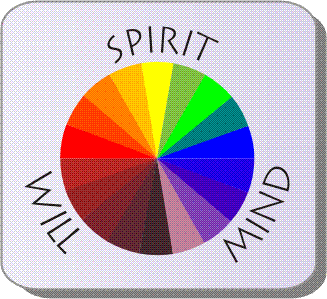
| CONCEPT | “HABIT” and “REVIEW A HABIT” introduce the Will/Mind concept. |
| ADVANCE | Go to the TABLE OF CONTENTS for more detail on opening the door to the Labyrinth of the Spirit, with TRUST being an important issue. |