| INSTINCT |
When instinct works, behavior is automatic. A negative example—
if something hurts or is known to cause harm, avoidance is instinctive—
like a burn. |
| PROBLEM OR ISSUE |
Concerned with a problem or issue?.
"Problem" implies "solution." When concerns are problems created by issues,
the issue may be retired, but not the original concern. With the concern
not resolved, the issue surfaces again with a different symptom. |
| ERROR |
Error is commited with biased behavior or
thinking. Continuing the error is
usually because of refusal to admit a mistake. The tendency is
to "dress up" results, rather than change them, because it looks
like the easiest thing to do. The error
might not be perceived. Nevertheless, errors
can be learning devices. "I won't do that again!" is intended, and when meant,
becomes instinctive after learning a new way. Please note that
Charles Munger, a successful investor (Berkshire Hathaway) keeps a list of
errors to avoid (a learning device). |
| THE WILL |
The Will is fast and efficient. Rather than stopping to think,
the Will operates habitually. After all, what has worked before
should work again, and usually does. |
| RESULTS |
Habits work, but if few are satisfied to the harm
of many, the habit is questionable. |
| CONSEQUENCE |
Actions have consequences. Action having harmful, not helpful,
consequences should be avoided—which is not always immediately
apparent. Selfish can look generous. If the consequence of habit isn't
satisfactory, creating a new habit will use the learning process. |
| THOUGHT |
Thought requires proof.
If a behavior doesn't work, instinctive behavior(a habit), may need review.
In the Labyrinth, each model uses a straight line process, but the Will,
to be fast and efficient, takes short cuts to produce the effect it wants.
The Will Model is organized into Stimulus, Willpower, and Effect.
The Mind Model is organized into Stimulus, Decision, and Effect.
In Will's automatic behavior, proof is the observation that what worked before
will work again.
In Mind's thoughtful behavior, every decision wants proof of its veracity, and
has different effects.
The Mind takes shorter cuts than the Will, but decisions and proof require
thought, which makes it much slower. Click on Key Reasons, above).
'Practice makes perfect' describes how the learning process of the Mind
becomes the automatic action of the Will. |
|
Critical thought compares and chooses. Comparison requires thought,
imagination, and proof.
The Labyrinth of the Spirit's Mind Model uses Proof. Real
thought is critical thought. |
| THE MIND |
The mind serves two functions. The first function is to rationalize
Will's behavior. The second is that true/critical thinking requires proof.
The Mind may decide to continue habits, or change them with the
learning process. |
| WILLPOWER |
Will has Willpower. The strength of the Will manifests itself with
Willpower. Willpower either chooses to continue a behavior, change it,
or end it. Mind is a tool of the Will, and its use is subject to the
intent behind the power of the Will. Will uses Mind to validate or
invalidate choices, which is the learning process.
Willpower can surmount Force of Habit. |
COMMUNICATE |
To share, communicate. Words are often considered THE mode
of communication when words are A mode of communication.
Radio, TV, speeches, conversations, sounds, gestures, alarms, colors,
shapes, internet, and some not in awareness are viable. All are
different media, and each communication must be aware of the
media's limits. This says that every communication and
its sharing is limited. Besides, a fraction of communication is
verbal, because nonverbal communications reveal fact. |
|
Real communication is two-way. A good example is a conversaton between two people.
One sends a message, and the other responds according to what was perceived in the
words, expression, gestures and other content of it, including the context
in which the message was delivered. This co-respondent then sends a message, and
the other responds. This continues until an agreement, if not understanding, is
reached. One-way communications that cause action can be taken as two-way.
In mass communications, statistical consequences are the response.
Measuring these consequences is a way to determine the communication's success—
when the co-respondent takes action as a result. It seems two-way. |
| SMR |
Sender-Message-Receiver(SMR) describes communication, whether one
or two-way. Perceive how the limitations of the sender, the media,
and the receiver affect the message. Does the context allow two-way
communication? |
|
SMR seems simple, but its application is very complex. |
| STIMULUS |
Action is stimulated. The action can be a message, an emotional,
mental, or physical response or reaction, an acknowledgement, the
first of a chain of actions, no apparent response, or action
taken much later.
In the Will Model, SMR is SWE(Stimulus-Willpower-Effect).
In the Mind Model, SMR is SDE(Stimulus-Decision-Effect). |
| CAUSE & EFFECT |
Cause & Effect are a concern. For the Will, Stimulus and Willpower
cause the effect. In the Mind, Stimulus and Decision cause the effect.
Many vehicles for perception exist, and perceptions define stimuli.
Even though some perceptions are beyond comprehension, they perhaps
have less limits, producing powerful causes and effects. |
| PERCEPTION |
Conscious perception is limited. The main conscious vehicles
for perception are the five senses: smell, hearing, touch, taste,
and vision. Each has limits, and since some value the senses as
the only sources of perceptions, opinions about the cosmic order,
mythic stories, and facts are invented to honor these limits. |
|
Pre-conceived perception(s) see pre-conceived effects. When bias is honored, bias
is maintained, and bias is continued. |
|
Open minds accept possibilities. |
DECISION
& EFFECT |
Decisions change behavior. The fast and efficient Will forces
a desired effect. When perceptions produce undesirable effects,
the Mind uses the Learning Process to change behavior. Stimulus
is the same, but Decision (rather than Willpower} determines
the effect. |
| PROOF |
In Mind, Stimulus, Decision, and Effect all require proof!
If built on bias (a weak premise), this foolproof structure rests
on a weak foundation. A strong foundation is necessary. |
|
Valid insights can be instinctive and automatic. Once a premise (an insight)
has proven to be valid, Willpower overcomes "Force of Habit" and runs an
efficient operation. |
WILL & MIND
MODELS |
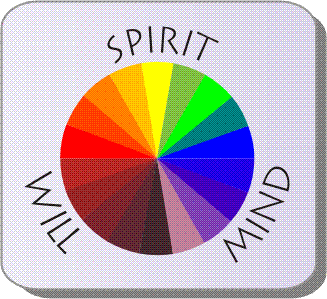
The Will Models show the automatic, instinctive effects
of Stimulus and Willpower. The Mind Models show the
Effects of proven Stimuli and Decisions. |
|
Each step in each model corresponds, even though seeming different because
each uses a vocabulary that suits the subject of the model. Each model and each
step is subject to characteristic error. |
| FEATURES |
. . . . . . . . . . . . . . . . . . . . . . . . . . . . . . . . . . . . . . . .
For Basics, go to Basic Concerns
For personal and system benefits, go to Benefits
For Keys to life's decisions, go to Key Reasons
To avoid error, go to Errors
To consider Habits, Learning, and Development, go to Start
For Purpose, Author info, and Motive, go to About
For definitions, go to Terms
To make contact and/or be a donor, go to Contact
For Habits, Go to Habit and Willpower
To enter the learning process, Go to Trust
For Table of Contents, Go to Table of Contents
For validation, go to Development
For concern theory, go to Concern Opens the Door
For Why? theory, go to Purpose
For error theory, go to Fallacy
For learning theory and personal values, go to Process
For choice guidance and theory, go to Choice
To use the Three Formats, go to the Labyrinth |
| Disclaimer |
The Labyrinth of the Spirit is an attempt to describe the human
condition, succeeding when helpful. |
|
Please feel free to discuss or argue its elements with skepticism.
To top. |