| DECISIONS |
The Labyrinth of the Spirit helps to manage life's decisions.
Not a maze! A maze has dead ends. A Labyrinth's path is toward
a definite goal. |
| MANAGED DECISIONS. |
Honor perceptions.
Honor concerns.
Honors the Will.
Honors Willpower.
Honors the Mind. |
| PROCEDURE IS: |
Flexible
Comprehensive
Focused
|
| WHY SPIRIT? |
No spirit, no will.
No will, no willpower.
Weak willpower, passive behavior.
Strong willpower, active behavior.
|
| HABITS! |
Doing by habit is fast and efficient.
Habits are learned behaviors.
To change a habit, learn a new way.
Learning requires thinking, which is slow.
Once the new way is learned, fast and efficient again! |
| ASSEMBLED CONCEPTS! |
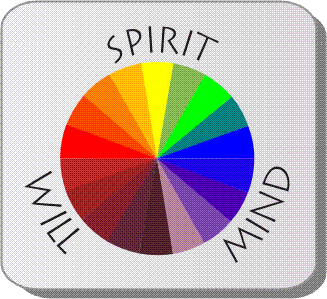
Changing habits uses the Will/Mind Concept (Explained in detail--See the link below.)
The Will Format shows how the Will works. The Mind Format shows how the Mind works.
Will is fast and efficient, but when in error, rethinks how, which is a job of the Mind.
Old behavior is changed to new behavior, and is fast and efficient again. |
|
Concern opens the door to resolution. |
|
Fallacy is being righteous, no matter the facts, compared to being right,
which depends on facts. |
|
Process Errors: Characteristic errors
sabotage the process. |
|
Choices: Choices have consequences. |
| CHOICE |
Choice is based on the consideration of fact over error,
and proceeds on the one given credit. Is it a choice between Will or Mind?
Between action or thought? Between positive or negative behavior? Between
rational or rationalization? Between excuses or explanation? |
| ERROR! |
The Will/Mind Concept is essential. Instinct
is fast and efficient. When wrong, Mind rethinks how—slow by nature,
because it takes time to perceive facts and analyze them. New thoughts
emphasizes existing concepts, modifies them, or replaces them. |