HABIT
To explore habits and errors to avoid, go to Habit and
Willpower.
habits repeated automatically are instinctive.
Humans are creatures of habit. Personality is defined by ideology.
Force of Habit is the name of habitual behavior. Certain stimuli have certain effects.
Good habits have good effects. Bad habits have bad effects.
Doing is habitual behavior. 'Thinking things over' brings about change. Thinking can
be learning.
Willpower decides.
For Willpower to change or modify a habit, go to Review a Habit.
(For the Table of Contents, click on the colored logos above.) |
|
LEARNING
The Labyrinth of the Spirit uses a learning process that helps to avoid
errors and do right.
A Labyrinth is not a maze, which has dead ends. It has a path that leads to a
definite goal. Spirit means 'in the spirit of the act.'
TRUST
Learning depends upon Trust.
Consideration may cause choice, but if the mind is already made up, the choice is easy—no choice.
Links to six(6) steps begin the Learning Process:
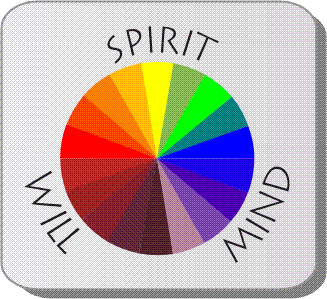
- The Will/Mind Concept.
- Concern: Concern opens the door.
- Purpose: Perception of fact
.
- Fallacy: Righteousness.
- Process: Learn.
- Choices: Choice has consequence.
|
|
DEVELOPMENT
Developed here is the reality of Being.
This can lead to rationality.
The Basis of the Labyrinth of the Spirit is developed in fourteen(14) steps.
- Being: Is real.
- Being aware: Manifests being.
- The Will: Create effect.
- Choice: Learn from choice.
- Willful Error Behavior: Error effects.
- Reasonable Behavior: Correct errors.
- Willing Behavior: Positive effects.
- Mindful Error: Choosing error.
- Willing Mind: Choosing the positive.
- Thinking Styles: Negative vs. Positive.
- Concerned Behavior: Focused behavior.
- Concerned Mind: Focused mind.
- Rational Behavior: Insight into an ideal.
- Rational mind: Proves the ideal.
|