| Equal steps |
Step 6 of the Model 17: Solution: asks What is wanted? Not
wanted? Step 6 in every model is similar, but in the vocabulary that suits the
subject of the model. Refer to the spreadsheet that lays out all the models.
In the spreadsheet, each step in every model is on the same horizontal line.
Vertical satisfies the language of the model: horizontal shows the correspondence between them. |
|
For example, including What is wanted? Not Wanted, step #6 of Model 6: Purpose
emphasizes Principle. Every step 6 supports the idea of using a Principle
based on What is wanted? Not wanted?,br />
Model 6s characteristic error: Blind acceptance is also
a concern of every step 6. Blind acceptance is acceptance based on what someone or something
else wants or not wants. |
|
The characteristic error of
Model 17 is Denial. Mistakes can accumulate: compounding
step #6s Blind acceptance with Model 17s Denial
is doubly dangerous! Blind acceptance plus Denial!?!?! |
|
The spiritual version of step 6 in Model 18: Revelation, is
titled a Period of settling down: Decide: give up or keep.
This is a Principle. |
|
The error of Model 18: Prejudice
describes a closed mind that does not acknowledge the existence of any model's resolution.
When considered in the 'spirit of the moment' or the 'spirit of intent,' all choices are spiritual,
because the learning process is the basis for Model 18: Revelation. |
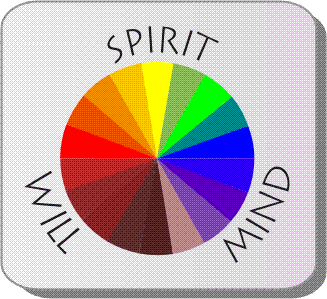
| Will & Mind |
When a behavior is learned and becomes fast and efficient,
it operates from the power of the Will Willpower. Whether learning came from
nature or nurture, 'willful' behavior doesn't work. Willpower uses the Mind to
reason new learnings. |
|
The Mind brings decision into the Process, and by requiring proof,
makes possible a change of Mind. Willpower needs to make the change
by overcoming the "Force of Habit."
When proven, what seems the best way is likely the best way. |
| First example |
Model 7: Relationship's step 4 is Respect: Value qualities.
This makes sense, because all parties in a relationship want to be valued for their
contribution. Is sorting out and valuing respect then, helpful? Anything could
seem valuable, but not without respect. Anything is unhelpful when it avoids,
rather than addresses, the concern! For example, drinking, drugs, and milder forms of
self-persecution are forms of self-avoidance that can be done courteously. But being
respected for 'keeping on drinking' doesn't seem helpful, does it? |
| Second Example |
Model 4: Resources's error is
False comparison. This error
applies to the entire model. Step 4 in every model is vulnerable to the same
error. Model 4's step 4—Value applies to use
—suffers froam a double whammy of False comparisons.
Model 7: Relationship's step 4 is Respect: Value qualities
. Qualities based on a False comparison virtually
guarantees a False relationship, and a
False relationship is the characteristic
error of the Model 7: Relationship model.
This is kind of a double whammy, too—mistakes made unconsciously. |
|
Staying with Model 7: Relationship. Its step 1 is Attract: Value
(or lack). Filling a lack
can create a False relationship when it is not
respectful, helpful, nor realistic. But filling a missing talent's lack with
another's talent can be very helpful when wholeness is created. Model 7's step 2 is
Promise: Indicates benefit. What benefit does the relationship
provide? A False relationship cannot provide real
benefit, or like in Model 18, promise real atonement. |
| Third example |
Step 9 in the Process of Model 18: Revelation, is Honesty:
Learn—no deception. Step 9 in Model 8: Communications, is
Concept: Language expresses concept. Meaning of any concept is
not achieved by making a biased concept. |
| Tolerance |
Step 10 in Model 18: Revelation is Tolerance: Love.
Step 10 in Model 8, Communications, is Means: Uses a medium, and
the 'tolerance' of each commmunications medium is a concern. Understanding the
tolerance of a medium's capacity is essential to conveying any meaning.
For example, a telephone conversation is different than face-to-face,
which adds other channels of expression—tone, gesture.expression, etc.
In the abstract, tolerance means acceptance. In the concrete, it means the working
limits of measurement. Everything has limits, called 'tolerance.' Communications
need be aware of the limits and capabilities of the medium. |
| More |
If more are wanted, please contact the webmaster.
These examples show how inter-related the models are. |
|
If more explanation is needed, please press Key Reasons
at the top of this page.
|
|
Back to Concern Opens the Door
 and click on "An Example."
To top. |