| Process |
Human beings have the natural ability to improve through
the Mind's Learning Process. When learned procedures become instinctive,
they are automatic. The Labyrinth of the Spirit acknowledges
instinctive Willpower and its tool Mind, showing their different advantages
while acknowledging their parallels. (It is a shame that instinctive
behavior is so often used to stifle improvement by promoting
questionable principles.) |
|
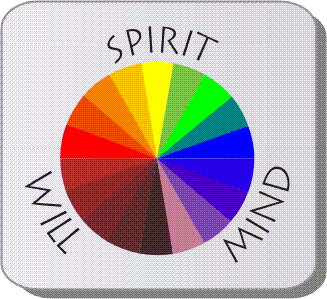
Will and Mind are interdependent. They respond to the same stimulus,
and the Will 'stops to think.' This emphasizes the slowness
of mental processes compared to automatic action. |
| Value |
The Learning Process—has a valuable objective.
Though each Model uses a vocabulary suited to it,
each step in each model corresponds to the same step in
every model. The objective of each step is the same as
the objective of all the models: Revelation—revealing
something better |
|
What is the concern? Generally answered by one of the models.
Click on the model's name (as listed below in this section). |
|
Errors typical to a stage in the
Process are listed.
If an error is repeatedly made, go to the Model associated
with that error. Umberto Eco, in Foucault's Pendulum, said:
"You cannot escape one infinite, I told myself, by fleeing to another; you cannot
escape the revelation of the identical by taking refuge in the illusion of the multiple."
Replacing the word infinite with the word definite, Foucault's statement still
holds true. Language uses many words (the "multiple") to describe the same thing
(the "identical."). For example, fear is a single emotion, but many words are
used to describe it, as if calling it by a different name changes it into something else. Fear is fear. |
|
The illusion of the multiple persists, perceived as real because many behaviors
hide behind multiplicity. Perceiving the identical, not differences, is a
valuable insight. Small insights into small truths promise the possibility of perceiving
large truths and eventually the largest, ultimate truth. Unless
prejudice prevails, becoming better is the objective. |
| Mechanics |
The Process is linked to the Model that intends to resolve
a particular concern, starting with
1. Insight, then 2. Extension,
and continuing to Model #18: Revelation. (Please note that
Model #18 summarizes the Process.)
The prime error, Prejudice,
misuses the Process by encouraging multiple errors. |
|
|
1.
Insight |
*Miracle
Having insight into a beneficial
help can be a miracle. Insight that is true only in certain circumstances may serve one circumstance,
but is false in others. Its characteristic error is
generalization, when truth in certain circumstances is generalized
to be true in all circumstances. |
2.
Extension |
Atonement
Atonement becomes 'at one' with
what the insight promises. The promise, by being 'at one' with
Self, includes the possibility of personal responsibility.
Personalization righteously projects
(or blames) responsibility on something or else someone,
which excludes the self. Assuming responsibility and extending it is inclusive.
Forgiveness, for example, extends and includes. |
3.
Objective |
Period of undoing
Becoming 'at one' with an
insight causes measurement and modification of existing
attitudes, beliefs, and goals. New objectives arise, replacing un-done
objectives. And, while modifications undo previously held values,
false evidence undoes the Learning Process. |
4.
Resource |
Period of sorting out
Measuring and modification leads to
comparison and setting priorities according to helpfulness.
What is helpful is a resource.
False comparison honors false resources. |
5.
Knowledge |
Period of relinquishment
Choosing what is helpful means
relinquishment of the unhelpful. Knowing the difference between
relinguishment and denial is helpful.
Emotional reasoning both denies and relinquishes this knowledge. |
6.
Purpose |
Period of settling down
Relinquishment can feel like
'giving in' or 'giving up,'; so a period of rest and
consolidation is necessary to settle on principles of help.
From these principles grows a new sense of purpose, summarized in the phrase:
"Give up what you do not want, and keep what you do."
Blind acceptance settles on other's principles, outmoded
principles, or lack of purpose. |
7.
Relationship |
Period of unsettling
New principles, new purpose, and possible
changes in relationships create reorganization, which is temporarily unsettling.
But blaming change on the wrong principles establishes false
relationships, which is definitely unbalanced and unsettling.
Ask: What is really wanted? |
8.
Communication |
Period of achievement
New principles, purpose, and relationships
create new communications. Effective new communication is an achievement.
But if pre-conceptions dominate,
broadcasting is achieved, but not communication, which is two-way. |
9.
Involvement |
Honesty
Relationships need honesty for trustworthy involvement.
Weak involvement creates a shaky, untrustworthy foundation.
False construction on a sound foundation
also proves untrustworthy. If honesty is absent, involvement of any
kind is unhelpful, and therefore false. |
10.
Means |
Tolerance
Honest construction is aware of the tolerance built into its
components, without pre-judging how they 'should' behave. Tolerance
means accepting differences when building relationships, yet being aware of
what they do and don't provide.
Invalid conjugation creates poor fits,
making tolerance meaningless. |
11.
Method |
Gentleness
Of all techniques, gentleness
promises productivity. The opposite of gentleness
is brutality—definitely unproductive.
False credit is given to brutal, clever, or
forceful methods. All of them, though maybe immediately productive,
eventually prove destructive. |
12.
Verify |
Joy
Joy is a too simple a definition for an emotion
resulting from the success of helpfulness. The word
'happiness' seems to make more sense, but happiness
verified is joy! Jump to conclusion
that behavior involves harm, pain, or sacrifice, and the behavior
becomes harmful, painful, or sacrificial—none of which bring joy. |
13.
Performance |
Defenseless
Joyful behavior is free of defense, but experience has shown
that an attack needs defense—but defense can create an attack that doesn't
exist, which denies reality. Denial actually acknowledges reality by
pretending it doesn't exist, but reality can't be eliminated!
Is there really an attack, or just perception of an attack. Defense against a
perceived attack creates attack when none was intended.
Consider the opposite. If an attack, real or not, meets no defense, can it continue?
Defense that encourages or creates continuation is a false cause,
but falsity is itself defenseless. The statement: "the best defense is a good offense"
implies that confused semantics define both. Confused semantics are a
false cause |
14.
Leadership |
Generous
Generosity needs definition. First: Only what is
possessed can be given away. Second: If loss occurs to either giver or receiver,
it is not generosity, but a trade or sacrifice. Third: True generosity is a
gift that brings increase to both giver and receiver. Ask this: Does the action called
generosity satisfy these definitions? A true leader is aware of these conditions.
Wishful thinking can make greedy behavior appear
generous—which is a very common error.
How would you like leaders to be? Generous, or selfish masking as generous? |
15.
Importance |
Patience
The truly generous can be patient, because true
generosity is returned, sometimes in ways unforeseen, unknown, often
unpredictable and unappreciated. False identification
can credit behavior to an erroneous cause. Patiently waiting to perceive
the actual cause is important. Remember the quote about the effects of the
200-year-old French Revolution in the 20th century: "It's too early
to tell." Also consider this advice: "Don't have an investment
in the outcome." Intent matters, not immmediate results! |
16.
Opportunity |
Faith
Faith provides the opportunity to trust in a context
that is honest, tolerant, gentle, joyful, defenseless, generous, and patient.
Faith is worthy of commitment. Avoid unhelpful and unworthy
false contexts. Appreciate and have faith in helpful contexts
that offer opportunity. |
17.
Solution |
Open-Minded
Open minds seek solutions. Closed minds
deny solutions. Forgiveness is a quality of the open mind that
intends to see the reality of every situation. In open-minded forgiveness,
since guilt and blame are not valued, they are not projected, so judgments
that discourage solutions are let go. Denial
intentionally closes the Mind to possible solutions. |
18.
Revelation |
Revelation
Validation of an insight is a revelation of understanding.
Open or closed minds, truth or falsity, equality or inequality, possibility and
probability, solution and resolution, knowledge and wisdom—all offer choice.
Prejudice does not acknowledge the
existence of choice, avoiding the miracle of a good insight.
Prejudice unconsciously closes the Mind to resolution. |
|
|
Self-
directed |
The Labyrinth's gentle consistency may not be immediately apparent,
for the Process can be construed as directive. But, since choice is always available,
the Learning Process is self-directed. Self-direction has
real value when answering "What is the concern?"
Intent makes the Process meaningful. |
|
Self-direction creates a labyrinth in which the goal is certain.
Lack of self-direction leads into a maze of
mistakes and dead ends. |
|
Does self-direction have meaning? The act of questioning requires conscious awareness,
which proves that awareness exists because the question was asked. Self-direction may choose
other-direction, relinquishing the responsibility for answering the question to some other
entity. Relinquishing responsibility eliminates self-direction. Turn the question
around: Does meaning have self-direction? If meaning comes from another, then the self has
no meaning—self-direction is absent! Self-direction is essential to finding
meaning—it is inclusive, not exclusive. Want to make self-direction meaningless? Separate
meaning from it. That's exclusion—and it doesn't work. Self-direction has meaning. |
|
Different abilities and experiences make self-direction unique.
This website acknowledges uniqueness.
Using the Process to its fullest potential requires self-direction,
which is self-determination. |
Self-
determined |
A person in good spirits perceives the world differently than one depressed,
and acts accordingly. Perceiving, feeling, and doing are all affected by the
underlying attitude held at that moment. The Labyrinth calls it
the 'spirit of the moment.' What happens
in the moment comes from an attitude either acquired recently or nurtured and
held for a long time. "It is done to us as we believe" says
that self-determination prevails. |
| Willpower |
Self-determination is Willpower. If the Will, using its quality of Mind,
sees a need for modification or change of habit,
Willpower is used to make the change. |
|
Willpower is instinctual. The instinctive drive for survival, for example, is called the
"will to live." In lesser terms, it can be the will to have one’s way,
the will to let go, or the need to be subject to a greater will. Willpower seeks satisfaction, but the
method chosen can hinder that satisfaction. See Reasonable Behavior
for the contrast beteen not thinking and reason. |
|
Willpower may be too weak to make the needed change, and seek refuge in
diversions, like addiction, for example, thereby sapping its power. Whatever
refuge is chosen is usually explained logically and reasonably, if explained at all.
This explanation is normally after a choice has been made, not before.
Hopefully, the logical and reasonable explanation is not a rationalization,
but rational. Having 'no explanation' indicates that Willpower
has denied perceptions. |
|
When a change is made, Willpower decides. |
| The Mind |
The Mind uses proof to verify its reason. Many proofs,
designed for a particular situation, are incomplete by being
suitable for a narrow discipline, but not trustworthy for
a general situation. It is true that the Mind, using Willpower,
often justifies behavior in a seemingly logical, reasonable manner,
cleverly hiding what is, basically, a mixed message, perverting
language and making fallacious use of the quality of mind. |
|
Proof is reasonable, checkable, and reliable in many disciplines. A
six-step, scientifically proven method used in the Labyrinth.
The Mind models call it Proof.
(Please see Willing Mind for the contrast between
Negative Thinking and Positive Proof). |
| Proof |
Behavior may appear reasonable, but have results that prove its
insights faulty. Sadly, sometimes rigorous Proof
is used to support this faulty insight. However,
perceiving falsity opens the door to reality, where proof
fortifies honesty and fairness, thereby deserting falsity. |
|
(Recent studies have indicated that people are more sensitive to
fairness than logic). It is encouraging that what appears to be
fair can be proven fair.) |
| Choice |
Choice manifests either continuation or change. Choice
is the Will manifesting emotionally, physically, mentally and/or
spiritually. Sometimes, no choice is made because being
right is more important than doing right.
Then, righteousness is more important than right.
The choice is still self-determined, which is then manifest in behavior. |
| Validity |
The validity of the Process depends upon its rationale.
It grew from a problem-solving method developed into the
Learning Process. Essential to the Process is the self-determining
ability to choose. Choice, though not always apparent, is always
available. Perceptions create viewpoints that either limit or expand
the awareness of choice. Fortunately, subtle changes in awareness
cause subtle changes in behavior. Although the results of a choice
may be small or large, revelation is the objective, with Revelation
as the ultimate objective. |
| Examples |
Click Examples of
using the Process.
To top. |
|
For choices, go to Choices |